Who Are the Top Solar Power Lights Manufacturers in China?
Solar Power Lights are no longer judged by brightness alone. Buyers also examine battery life, charging performance, weather resistance, and repair access. These details matter when a pathway stays dark for hours or a garden fixture faces weeks of rain. The IEA’s Renewables 2024 report projects nearly 5,500 gigawatts of renewable capacity additions worldwide between 2024 and 2030. Solar PV is expected to provide almost 80% of that growth. That forecast concerns power capacity, not lighting-unit sales. IEA Executive Director Fatih Birol called solar “the new king of electricity markets” in the agency’s World Energy Outlook 2020. His phrase captures solar’s momentum, but a compact lamp still succeeds or fails on practical design. Not just watts.
This guide compares Chinese manufacturers through product engineering, production capability, and evidence buyers can verify. Useful signals include battery capacity, panel specifications, ingress protection, warranty terms, and replacement-part availability. Factory photos alone prove little; test reports, sample consistency, and clear communication deserve closer scrutiny. A rural walkway, a resort garden, and an emergency kit rarely need the same lamp. Price matters, too, but low bids can conceal shorter battery life or thinner housings. Those trade-offs are easy to miss. No ranking can replace testing a sample under real conditions. Still, applying the same criteria to each supplier makes a shortlist more useful and less promotional. The manufacturers featured here are starting points, not automatic endorsements.
China’s Solar Lighting Context: 886.66 GW of PV Capacity by End-2024
China’s photovoltaic capacity reached 886.66 GW by the end of 2024, making solar energy a major part of the country’s power landscape. This figure measures installed capacity, not electricity produced every hour. Output shifts with weather, daylight, location, and system conditions. That distinction matters.
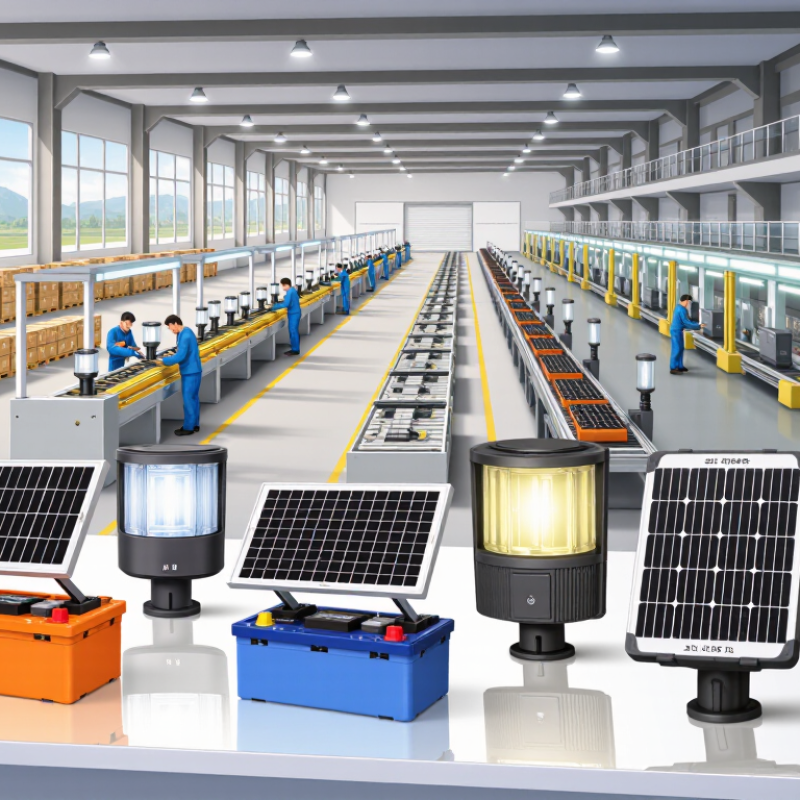
For solar lighting, this scale points to a broad ecosystem for panels, batteries, charge controllers, and LED components. It can support manufacturing experience and supply-chain coordination. But national capacity cannot prove that a particular outdoor light performs well. A garden path in cloudy Sichuan faces different conditions from a warehouse yard in sunny Gansu. Battery sizing, panel angle, shade, temperature, and operating hours all affect reliability.
It is tempting to treat the headline figure as proof of product quality. That would be a mistake. Compare lights against the intended use: required brightness, nightly runtime, mounting position, and maintenance access. Ask for test results with clear conditions, not just a wattage label. Small details count. A unit may run well in summer, then dim earlier in winter. That limitation should be stated plainly.
How Solar Power Lights Work: PV Panels, LEDs, Controllers, and Batteries
A solar power light is a small off-grid system. In daylight, its photovoltaic panel converts sunlight into direct-current electricity. A charge controller regulates that energy, protects the battery from overcharging, and switches the lamp on after dusk. Many controllers use maximum power point tracking to improve energy harvest when sunlight or panel temperature changes. Small details matter. Panel angle, dust, and nearby shade can all reduce charging.
The battery stores energy for evening use, while LEDs turn it into light with relatively little power. The U.S. Department of Energy reports that LEDs use at least 75% less energy than incandescent lighting, though that comparison does not predict a solar lamp’s runtime. IRENA’s Renewable Capacity Statistics 2024 records 1,419 GW of installed solar capacity worldwide at the end of 2023. That growth supports a mature PV supply chain, but it cannot guarantee a well-designed light. Engineers still need to match panel output, battery capacity, and nightly operating hours to local weather. Cloudy weeks expose weak sizing. And a controller’s settings are easy to overlook. A longer battery-life estimate may look convincing on paper, yet real performance depends on temperature, shading, and how consistently the lamp is used.
How Solar Power Lights Work: A Daily Energy Example
This illustrative example assumes a 10 W solar panel receives 4 peak sun hours per day, producing 40 Wh before system losses. At an assumed 75% net system yield, about 30 Wh is available for lighting. A 3 W LED used for 8 hours consumes 24 Wh. The controller manages battery charging and LED operation; actual performance varies with sunlight, installation, and component efficiency.
Chinese Manufacturers to Compare: SOKOYO, Anern, LUXMAN, Leadsun, and Cmoonlight
When comparing Chinese solar-light manufacturers, look beyond catalogue brightness claims. Ask for the panel wattage, battery chemistry, lamp efficacy, and rated operating temperature. These details help explain how a light may perform after several cloudy days. Request a sample test report, warranty terms, and clear definitions of expected runtime. Check whether the supplier can provide drawings for the pole, mounting brackets, and cable layout. Small details matter.
A useful comparison also includes production capacity, customization options, and after-sales support. Ask how the company tests water resistance and battery protection, and whether test records match the exact model being quoted. If possible, review a sample unit outdoors at dusk and again before sunrise. That reveals practical issues a brochure may miss. I would not treat a polished catalogue as proof. Supplier claims can be difficult to compare, especially when test conditions differ. A simple side-by-side checklist helps, though it will not replace an independent technical review. Some buyers overlook replacement-part access. That can be a costly mistake.
Solar Power Lights: Manufacturer Comparison Criteria
| Comparison Dimension |
What to Compare |
Evidence or Reference |
| Solar module |
Module technology, rated power, dimensions, and performance under the project’s sunlight conditions. |
Request the module datasheet and test documentation. IEC 61215 covers design qualification and type approval; IEC 61730 addresses module safety qualification. |
| Battery |
Chemistry, nominal voltage and capacity, usable energy, operating-temperature limits, and replacement arrangements. |
Request battery and battery-management-system specifications, plus the stated test conditions behind cycle-life claims. Compare usable energy, not capacity alone. |
| Lighting performance |
Delivered luminous flux, efficacy, light distribution, correlated color temperature, and performance at the intended mounting height. |
Ask for a luminaire datasheet and photometric files, such as IES or LDT, so the proposed layout can be checked for the specific application. |
| Ingress protection |
The IP rating of the complete luminaire and the components most exposed to water and dust. |
Check the test report and the exact product configuration. IEC 60529 defines the IP Code; an IP rating describes enclosure protection, not overall product quality. |
| Impact resistance |
Resistance of the relevant enclosure or optical parts to mechanical impact. |
Request the test report and confirm which parts were tested. IEC 62262 specifies IK codes for enclosures’ resistance to external mechanical impacts. |
| Electrical and luminaire safety |
Applicable safety standards, electrical protection, and whether test documents cover the supplied model. |
For road and street lighting, ask which applicable parts of the IEC 60598 luminaire-safety series were used and request model-specific documentation. |
| LED lifetime claims |
The basis of LED package lifetime estimates and the conditions used for projections. |
Request LED-package maintenance data and the projection method. IES LM-80 covers measurement of LED light-source maintenance; IES TM-21 provides a method for projecting long-term luminous-flux maintenance. |
| Autonomy and controls |
Operating hours, dimming schedule, motion response, and expected backup during low-sunlight periods. |
Request the energy-balance assumptions, including location, seasonal solar resource, load profile, and battery reserve. Autonomy depends on the system design and site conditions. |
| Warranty and service |
Warranty duration and coverage for the luminaire, battery, solar module, and controller, as well as spare-parts availability. |
Review the written warranty for exclusions, remedies, shipping responsibilities, and claim procedures. Warranty terms are supplier-specific and should be compared directly. |
Note: This is a comparison checklist, not a set of specifications for any particular manufacturer or product. Confirm current standards, certificates, and test reports for the exact model and destination market.
How to Assess Products: IP65/IP66 Ratings, LED Efficacy in lm/W, and Battery Life
For solar lighting products, read IP ratings as test conditions, not promises of invulnerability.
Under IEC 60529, IP65 means dust-tight and protected against water jets; IP66 withstands more powerful jets. Neither rating means the lamp can be submerged. Ask whether the rating applies to the complete assembled fixture, including cable glands and battery enclosure. That detail matters after months of windblown dust and rain. A label alone is weak evidence.
Compare efficacy in lumens per watt (lm/W), but check whether the figure describes the LED package or the complete luminaire. The U.S. Department of Energy’s 2022 Solid-State Lighting R&D Opportunities report notes that advanced LED packages can exceed 200 lm/W under controlled conditions; optics and electronics reduce real fixture output. Ask for test reports showing delivered lumens and input watts.
Battery claims need equal scrutiny. IEC 61427-1 sets testing methods for batteries used with renewable-energy systems, but it does not guarantee a particular service life. Request rated capacity in watt-hours, cycle life at a stated depth of discharge, and test temperature. I would also check whether the warranty covers capacity loss. A tidy “five-year life” claim can hide assumptions about mild weather, shallow cycling, and ideal charging. Those conditions may not match a cold, cloudy site.
Applications and Standards: Street, Garden, and Industrial Lights under IEC 60598
Solar street lights must do more than switch on after sunset.
Their optics should place light on the road, not into nearby windows or the night sky. Pole height, spacing, and road width all affect the result. A lighting plan should use measured photometric data, not panel wattage alone.
IEC 60598-1 sets general safety requirements for luminaires, while relevant Part 2 sections address specific types. Road and street luminaires are commonly evaluated under IEC 60598-2-3 alongside Part 1. Solar power does not remove these checks. Enclosures, wiring, insulation, and temperature rise still matter.
Ask for test reports that match the actual product configuration. A tidy datasheet may not tell the whole story.
Garden lights face different conditions. They may sit beside sprinklers, damp soil, or gravel paths, so ingress protection and stable mounting deserve close attention. Industrial lights often need stronger housings, corrosion resistance, and predictable performance across long operating hours. The right IEC 60598 provisions depend on the luminaire’s design and intended use. Check the rating label, installation instructions, and test evidence together.
Field conditions can still surprise you. A small shade from a tree may cut charging time, and that detail is easy to overlook.