
China Top Linked Smoke Detectors Manufacturers
China has become an important sourcing base for connected fire-safety products, including Linked Smoke Detectors for homes, hotels, offices, and industrial sites. These devices can send alerts between units, helping occupants notice smoke beyond the room where it begins. But a shared connection is only useful when it works reliably. Buyers should look beyond product photos and compare communication range, alarm volume, backup power, app support, and installation requirements.
This guide introduces China’s top linked smoke detector manufacturers and explains what to check before requesting a quotation. Review product specifications, factory experience, sample performance, quality-control procedures, and documentation for the intended market. Ask how devices behave during a network interruption and whether compatible units can be tested together. Small details matter. A clear pairing process can save time during installation, while unclear instructions can cause avoidable delays. Manufacturer claims should be confirmed with current records and hands-on evaluation where practical. Not every connected model suits every building, and a low price alone says little about long-term reliability. That is easy to forget. Use the comparisons ahead to narrow suppliers carefully, then verify the details that matter for your project.
What Linked Smoke Detectors Are and Where They Are Used
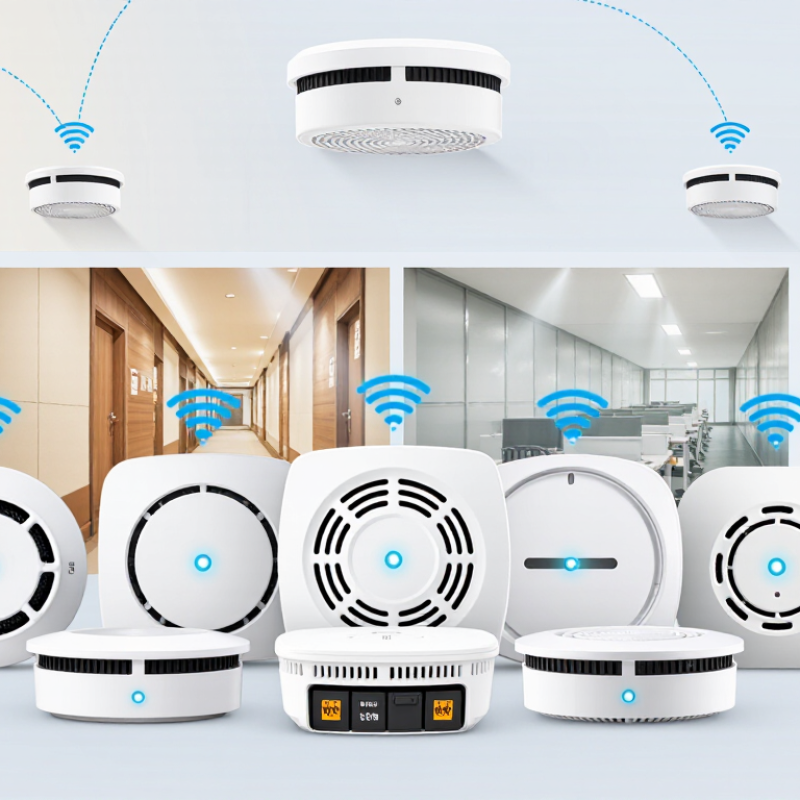
Linked smoke detectors are units connected so that one alarm can trigger the others. If smoke is detected in a kitchen-side hallway, alarms in bedrooms may sound too. This shared warning can help people farther from the source hear danger sooner. Linked systems may use wires or wireless signals; compatibility depends on the devices.
They are useful in multi-storey homes, long corridors, and buildings with bedrooms separated from living areas. In a small flat, one alarm may be easy to hear, but doors, fans, and background noise can affect audibility. A linked system is not a substitute for careful placement. Follow the device instructions and local safety guidance, and check that alarms can be heard from sleeping areas.
Tips: Test each unit regularly, including linked alarms. Replace batteries or devices as directed. A layout can look sensible on paper, yet a closed bedroom door may muffle a warning. Walk through the home while someone tests the system, and note any quiet spots.
How Interconnected Smoke Detection Systems Work
An interconnected smoke detection system lets one alarm alert the others. When a detector senses smoke, it sends a signal through wiring or a wireless link. Alarms in bedrooms, hallways, and living areas then sound together. That matters when a fire starts behind a closed door or far from where people are sleeping. Some systems also send alerts to a control panel, but features vary by design. In practice, installers need to check device compatibility, signal coverage, and backup power. A weak wireless link can leave a quiet gap.
The National Fire Protection Association’s report Smoke Alarms in U.S. Home Fires found that alarms were present in 74% of reported home fires from 2014 to 2018. The death rate per 1,000 reported fires was about twice as high in homes without alarms as in homes with them. Interconnection can help occupants hear an alarm sooner, but it does not replace regular testing. Press each test button as the manufacturer directs, and check that every linked unit responds. A network is not magic. Dust, depleted batteries, or a failed connection can undermine it; that is easy to overlook in a newly installed system.
How Interconnected Smoke Detection Systems Work
Typical sequence: A detector senses smoke and sounds its local alarm. It then sends an interconnection signal so compatible linked alarms elsewhere can sound, helping alert occupants throughout the building. The bars show event order only—not measured time or performance. System behavior varies by installation.
Key Standards and Technologies in China’s Smoke Detector Industry
China’s smoke detector industry is shaped by both product standards and installation requirements. GB 4715 sets technical requirements for point-type smoke detectors, including alarm response and environmental performance. GB 50116 guides fire alarm system design, while GB 4717 covers fire alarm controllers. Manufacturers and buyers should check the applicable editions and product certification before specifying equipment. Details matter.
Connected detectors add another layer. Optical sensing remains common because it can detect smoke particles without relying on heat alone. Some designs combine sensing methods or use compensation algorithms to reduce nuisance alarms caused by dust or changing temperatures. A linked unit may send an alert to a controller or monitoring platform, but dependable communication depends on network coverage, power backup, and compatible interfaces. A clever app cannot fix a weak radio signal.
In practical testing, installers should check alarm audibility in closed bedrooms, not only beside the device. They should also test links between units and confirm what happens during a power or network interruption. Self-diagnostics can reveal low battery or sensor faults, yet they do not replace cleaning and scheduled inspection. This is an imperfect area: connected features are advancing quickly, while interoperability and long-term maintenance can still be uneven across projects. Buyers should ask for test records, clear fault indicators, and documented service procedures.
China Top Linked Smoke Detectors Manufacturers – Key Standards and Technologies in China’s Smoke Detector Industry
| Dimension | Standard or Technology | Industry-Relevant Information | Practical Consideration |
|---|---|---|---|
| Point-type smoke detector requirements | GB 4715-2024, Point-Type Smoke Fire Detectors | This product standard addresses performance and test requirements for point-type smoke fire detectors used in fire alarm systems. | Confirm the edition and implementation status applicable to the project, and check that the detector’s certification and test documentation match its intended use. |
| Fire alarm control equipment | GB 4717-2024, Fire Alarm Control Units | Fire alarm control units receive and process signals from compatible detection devices and provide system-level alarm and fault indications. | Check detector-to-panel compatibility, supported circuit configuration, addressing method, and fault-reporting behavior. |
| Fire linkage and system control | GB 16806-2006, Fire Linkage Control System | Fire linkage control equipment coordinates specified fire-safety actions in response to fire alarm signals. | Define cause-and-effect logic and interfaces with other equipment during system design; do not assume every detector directly controls building systems. |
| System design | GB 50116-2013, Code for Design of Automatic Fire Alarm System | This national engineering code provides design provisions for automatic fire alarm systems, including system arrangement and device application. | Detector selection, placement, and interconnection should be determined by the building design, environment, and applicable code provisions. |
| Installation and acceptance | GB 50166-2019, Code for Installation and Acceptance of Fire Alarm System | This code covers installation, commissioning, and acceptance of fire alarm systems. | Include wiring checks, device addressing, alarm and fault testing, and documented commissioning in the acceptance process. |
| Standalone alarm product distinction | GB 20517-2006, Standalone Smoke Fire Detection and Alarm Devices | This standard relates to standalone smoke detection and alarm devices; such devices are not automatically equivalent to addressable system detectors. | Verify whether the project requires an independent audible alarm or a detector connected to a fire alarm control unit. |
| Smoke-sensing method | Photoelectric sensing | Photoelectric detectors use changes in light caused by smoke particles to identify smoke. This sensing method is widely used in point-type smoke detectors. | Performance can be affected by dust, insects, steam, and installation conditions; select and maintain devices for the environment. |
| Multi-criteria detection | Smoke and heat sensing; signal processing | Some detector designs combine smoke measurements with heat or other sensor inputs and use signal-processing logic to improve event classification. | Features and decision logic vary by product. Confirm certified product documentation rather than assuming a particular algorithm or false-alarm performance. |
| Wired system connection | Addressable or conventional circuits | Addressable systems identify devices individually on a compatible circuit; conventional systems generally report alarms by circuit or zone. | Match detector type, wiring, communication protocol, and circuit limits to the control unit and approved system design. |
| Wireless connection | Radio-frequency links and gateways | Wireless designs may communicate with a receiver or gateway that connects to the fire alarm system. Radio performance depends on the building and system configuration. | Check local regulatory requirements, radio coverage, interference resilience, battery supervision, and loss-of-link fault reporting. |
| Remote monitoring | Panel interfaces and monitoring networks | Fire alarm systems may provide alarm, supervisory, and fault information to an approved monitoring arrangement through compatible interfaces. | Remote monitoring supplements, but does not replace, compliant local detection, control equipment, installation, and maintenance. |
| Product conformity | Applicable certification and test documentation | Fire alarm products may be subject to China-specific conformity and market-access requirements depending on product category and current regulations. | Verify the current requirements for the exact product category with the relevant certification or regulatory authority before procurement. |
Note: Standards, certification rules, and project requirements can change. Confirm current editions and applicability with the official standards publications and relevant authorities before design or procurement.
Leading Chinese Linked Smoke Detector Manufacturers and Their Products
China’s Linked Smoke Detector Manufacturers and Their Products
Chinese manufacturers offer linked smoke detectors in several configurations: radio-frequency networks, Wi-Fi-connected units, and systems using a central gateway. Many product lines pair photoelectric sensing with audible alarms and wireless communication. Some also combine smoke detection with carbon monoxide sensing.
For buyers, the useful details are practical: interconnection range, alarm volume, battery life, and whether one triggered unit activates every detector. A hallway test matters.
The NFPA report Smoke Alarms in U.S. Home Fires, covering 2014–2018, found that working smoke alarms reduced the risk of dying in a reported home fire by 55%. It also found that alarms were absent or nonworking in a substantial share of fatal incidents.
This makes reliable linkage more than a convenience, though installation and maintenance still matter. A product sheet cannot prove performance in a concrete apartment with closed doors and weak wireless signals.
When comparing Chinese suppliers, examine test documentation, sensor type, communication protocol, fault alerts, and support for replacement parts. Ask whether alarms remain linked during a power interruption, and test the full system after installation.
Small details count. Export documentation may vary by destination, so check the standards applicable to the intended market. Specifications can look impressive; real-world range is sometimes less tidy.
How to Compare Manufacturers, Certifications, and Supply Capabilities
China Top Linked Smoke Detectors Manufacturers
When comparing manufacturers in China, look beyond unit price and catalogue claims. Ask which exact model and configuration is certified for your destination market, such as EN 14604 or UL 217. Check the certificate against the issuing body’s public listing. ISO 9001 indicates a quality-management system; it does not certify detector performance. Linked alarms also need practical compatibility checks: test pairing, alarm propagation, and recovery after power interruption. Small details matter.
NFPA’s 2021 report, Smoke Alarms in U.S. Home Fires, found smoke alarms were present in 74% of reported U.S. home fires. The report also found that 60% of home fire deaths occurred in homes without working alarms. These figures are useful context, not a forecast for every export market. Ask suppliers for model-specific test reports and verify that linked units were tested together, not only as separate devices. Paperwork can look tidy while production drifts. I still find this easy to miss.
Supply capability deserves the same scrutiny as certification. Request recent production lead times, monthly output, defect rates, component traceability, and written change-control procedures. Check whether the factory can maintain consistent wireless range and alarm timing across batches. Ask how it handles component shortages and firmware updates. Then compare sample results with the production inspection plan. A polished sample is not enough. A site audit or independent inspection can reveal gaps, though it adds cost and time.