
China Top HDPE Liner Manufacturers for Global Buyers
China’s position in the geomembrane supply chain makes it an important sourcing option for global buyers. Grand View Research’s geomembrane market analysis tracks demand across landfill, mining, water, and infrastructure projects. These applications share a practical need: a liner must resist punctures, chemical exposure, and long-term environmental stress. For procurement teams, the challenge is not simply finding the lowest price. It is verifying material quality, production consistency, and technical support before a shipment reaches the site.
An Hdpe Liner is commonly selected for its chemical resistance, durability, and suitability for large containment areas. Yet product names alone prove little. Buyers should review resin specifications, thickness tolerances, seam-testing procedures, and third-party test records. ASTM International standards and the Geosynthetic Institute’s GRI-GM13 specification provide useful technical reference points for evaluating HDPE geomembranes. Ask suppliers for recent test results and clear traceability records. Small details matter. A roll label, a weld sample, or an inconsistent thickness reading can reveal issues that a brochure will not.
China Top HDPE Liner Manufacturers for Global Buyers is therefore a sourcing topic, not a simple ranking exercise. Market reports, including analyses from Grand View Research, describe broad sector trends; they do not certify individual factories. Buyers still need to compare samples, production capacity, export experience, and after-sales responsiveness. No supplier is perfect. That is worth remembering. This introduction offers a grounded starting point for assessing Chinese manufacturers, while recognizing that project conditions and specifications can differ substantially.
What HDPE Liners Are and How They Are Used
HDPE liners are flexible sheets made from high-density polyethylene, a durable thermoplastic with low permeability. They create a barrier between soil and liquids or contained materials. Common uses include reservoirs, landfill cells, wastewater ponds, mining facilities, and irrigation canals. A liner is not a substitute for sound site design. It works as one part of a containment system.
Thickness, surface texture, and seam method should suit the site’s conditions. For example, a steep pond slope may need textured material to improve interface stability. Installation crews typically prepare a smooth, compacted subgrade, then join panels using tested thermal seams. Seams matter. Sharp stones beneath the sheet can cause punctures, while sunlight and chemical exposure may affect service life. Specifications should account for temperature, liquid chemistry, ground settlement, and inspection access. Real sites are rarely perfect; small wrinkles or uneven ground can complicate installation. That deserves honest planning. Regular inspections and documented seam testing help spot issues early.
Key Properties Buyers Should Compare
When comparing HDPE liner manufacturers, look beyond quoted price and nominal thickness. Thickness affects puncture resistance, but it does not tell the whole story. Compare tensile strength, elongation, tear resistance, and stress-crack resistance using test reports for the same product grade. A liner may look uniform on a roll yet behave differently under tension or around a sharp subgrade stone. Small differences matter.
Check the resin and carbon-black dispersion, too. Consistent dispersion supports UV resistance; poor distribution can create weak spots. Ask how the manufacturer controls thickness across the roll and verifies seam compatibility. Request current test data, production quality records, and a sample for visual inspection. Where the liner will face prolonged sunlight, chemical exposure, or uneven ground, match the specifications to those conditions. A specification sheet alone cannot show every installation risk. I would still question any comparison that relies on one headline strength value.
Tips: Compare like with like: same thickness, test method, and product grade. Check the roll edges and surface for visible defects. Ask for a sample seam before ordering large quantities. A rushed review can miss details. Recheck your assumptions.
How China’s HDPE Liner Manufacturing Industry Works
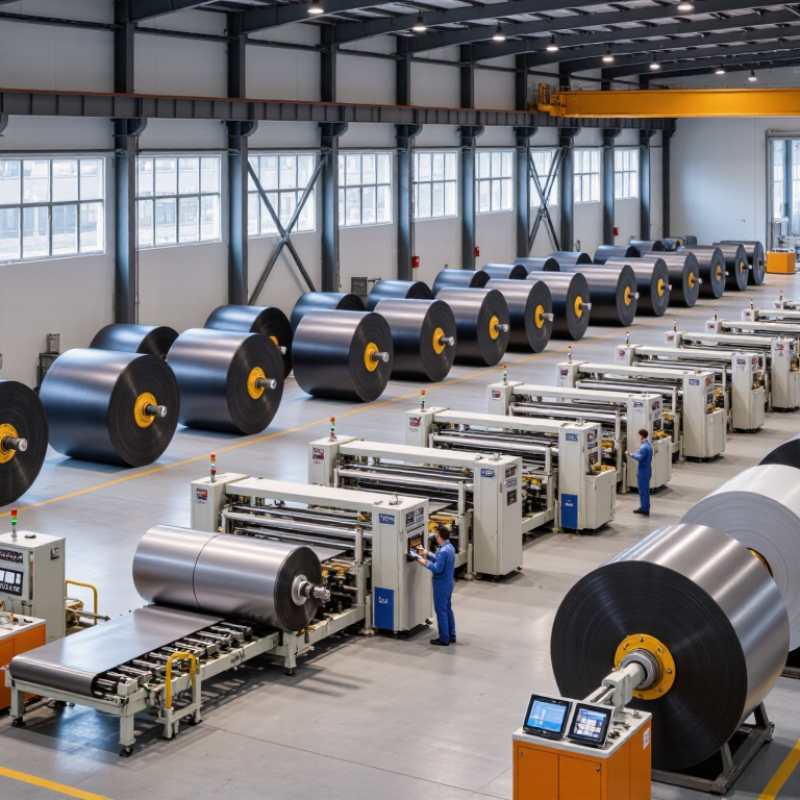
China’s HDPE liner manufacturing industry combines polymer processing, quality control, and export logistics. Production usually begins with polyethylene resin and carefully measured additives, including carbon black for resistance to ultraviolet exposure. The blend is heated and formed into sheets by extrusion or calendering. Small process changes matter. Temperature, cooling speed, and line tension can affect thickness and surface consistency.
Factories commonly produce liners in different thicknesses and roll widths for ponds, reservoirs, landfills, and mining projects. Buyers should compare more than quoted price. Ask for current test reports covering thickness, tensile strength, tear resistance, and carbon black dispersion. A sample roll can also reveal practical details, such as surface texture and ease of welding. Good documentation helps, but it cannot replace a clear review of production controls.
Quality systems vary between manufacturers, so buyers benefit from checking how raw materials are traced and how finished rolls are inspected. Packaging deserves attention too; rough handling can damage edges before installation. Factory capacity may look impressive on paper. Yet large capacity alone does not guarantee consistent batches or reliable delivery dates. Ask specific questions, and verify the answers. Even careful sourcing has uncertainties, especially when specifications are vague or project conditions change.
Criteria for Evaluating Chinese HDPE Liner Manufacturers
For global buyers, evaluating a Chinese HDPE liner manufacturer means checking repeatable production, not just a polished datasheet. Ask for roll-specific test records, resin batch traceability, and calibration logs for thickness gauges. The Geosynthetic Institute’s GRI-GM13 specification sets carbon black content at 2.0–3.0% by mass, a useful benchmark for UV protection. Confirm the figure through a recognized laboratory test, rather than accepting a brochure claim. Small details matter.
Review how the factory tests seams and handles failed samples. ASTM D6392 describes destructive testing methods for geomembrane seams; request recent results alongside the sampling frequency and acceptance limits. An independent laboratory accredited to ISO/IEC 17025 can add confidence, though accreditation alone does not prove consistent manufacturing. Ask to inspect production and quality-control records during an audit. Look for clear lot labels on rolls, not handwritten notes that can detach in transit. I would still question any supplier offering identical results for every batch; real production has variation. Compare data across several lots, and check that reported values meet the project specification.
| Evaluation Criterion | Practical Benchmark for Buyers | Evidence to Request or Verify | Why It Matters |
|---|---|---|---|
| Applicable product specification | Confirm that the proposed HDPE geomembrane meets the project specification and the applicable edition of GRI-GM13, where specified. | Product data sheet, declared standard and edition, and a clause-by-clause compliance matrix. | Standards and project requirements can differ; a general claim of compliance does not establish that every required property is covered. |
| Thickness and thickness tolerance | Specify nominal thickness by application. Common project selections include 1.0 mm, 1.5 mm, and 2.0 mm; the project documents should define the required tolerance and measurement basis. | Recent test results for nominal and minimum average thickness, plus roll labels identifying thickness and lot. | Thickness affects material quantity, handling, installation, and the design properties required for the project. |
| Resin density and material identification | Compare the declared resin density with the applicable product specification; GRI-GM13 includes a density requirement for HDPE geomembranes. | Batch-specific test reports and resin traceability records. Density testing is commonly performed using ASTM D1505 or an applicable equivalent method. | Traceability and test evidence help confirm that supplied material matches the approved product specification. |
| Tensile properties | Check yield and break properties against the required specification for the selected thickness and test method. | Independent or quality-control test results stating specimen type, test method, thickness, and results. ASTM D6693 is commonly used for tensile properties of geomembranes. | Tensile results support evaluation of the sheet’s mechanical properties during handling and service. |
| Carbon black content and dispersion | For black HDPE geomembrane, verify carbon black content and dispersion against the applicable specification rather than relying on color alone. | Test reports identifying the method and results; ASTM D4218 is used for carbon black content and ASTM D5596 for dispersion evaluation. | These properties are relevant to material consistency and resistance to ultraviolet exposure. |
| Oxidative induction time (OIT) | Review standard OIT or high-pressure OIT requirements, as applicable, against the project specification and the selected test method. | Test reports stating the OIT method, conditioning, and results. ASTM D3895 and ASTM D5885 are commonly used for standard and high-pressure OIT testing, respectively. | OIT testing evaluates antioxidant response; results should be interpreted within the specified method and project requirements. |
| Roll dimensions and packaging | Confirm roll width, length, thickness, core, and packaging format against site access, handling equipment, and installation plans. Dimensions are product- and order-specific. | Approved roll schedule, packing list format, sample roll label, and written confirmation of dimensional tolerances. | Accurate roll planning helps reduce handling difficulties, unnecessary seams, and delivery discrepancies. |
| Seam testing and installation support | Require a documented trial-weld and field seam quality-control plan appropriate to the project and joining method. | Welding procedures, technician qualifications where required, trial-weld records, and seam test procedures. ASTM D6392 covers destructive seam testing for nonreinforced geomembranes. | Field seam performance depends on installation conditions and workmanship as well as the sheet material. |
| Quality management and lot traceability | Expect a documented quality system and a clear link between production lots, test records, roll labels, and shipping documents. | Quality-system certificate with scope and validity confirmed, inspection plan, lot-specific certificates of analysis, and traceability samples. | Traceability makes it easier to investigate nonconformities and verify delivered rolls against approved submittals. |
| Independent inspection and testing | Agree in advance on sampling frequency, test methods, acceptance criteria, and whether testing will be performed by an independent laboratory. | Inspection and test plan, laboratory credentials, sample chain-of-custody records, and reports tied to specific production lots. | Pre-agreed verification reduces ambiguity during production, shipment, and material acceptance. |
| Export documentation and delivery planning | Confirm the required shipping documents, delivery term, destination port, packaging, and realistic production and transit schedule in the purchase contract. | Pro forma invoice, packing list, certificate-of-origin arrangements if required, shipping plan, and written schedule milestones. | Clear logistics requirements help buyers manage customs, site readiness, and delivery risks. |
| Warranty and claims process | Review the written warranty’s scope, exclusions, duration, notice requirements, and remedy; do not treat warranty length as a substitute for technical verification. | Contract warranty, claims procedure, response contacts, and documented process for handling nonconforming material. | Written terms clarify the parties’ responsibilities if a product or delivery issue arises. |
| Buyer note: Benchmarks are for supplier evaluation, not a substitute for project specifications. Confirm the applicable standards, editions, test methods, and acceptance limits with the project designer and contract documents. This table presents evaluation criteria only and does not identify or rank individual manufacturers. | |||
Sourcing, Quality Checks, and International Shipping Considerations
Buying an HDPE liner from China starts with a clear project brief, not just a price list. Specify resin grade, thickness, roll width, surface texture, seam method, and expected site conditions. Ask for a sample from the same production line and recent quality records. Check it closely. Measure thickness at several points, inspect the edges, and review tensile and oxidation-resistance test reports. Reports should identify test methods and batch numbers; without these details, comparisons are weak. It is easy to overlook that.
Before approving an order, request a documented factory inspection or an independent inspection. Check roll labels, winding, protective wrapping, and loading photos. A liner may arrive undamaged but still be awkward to install if its width does not suit site equipment. Measure twice. Written specifications can leave room for interpretation, especially around acceptable surface marks. Share clear examples and record agreed tolerances.
For international shipping, confirm roll dimensions and gross weights before booking a container. Ask how the rolls will be protected from moisture, punctures, and movement during transit. Request the packing list, commercial invoice, and bill of lading details, plus a certificate of origin if needed. Check import and labeling requirements with a local customs broker, since requirements and fees can change. Allow extra time for port delays and inland delivery. Keeping spare liner material on site may help with small repairs, though it adds cost and storage needs.
HDPE Geomembrane Thickness and Estimated Material Weight
Compare common nominal liner thicknesses with estimated material weight per square metre. Estimates assume a density of 0.94 g/cm³ and exclude packaging, cores, and other shipping materials. Confirm actual roll specifications and weights with your supplier before arranging international freight.
Estimated values are calculated as nominal thickness × 0.94 kg/m² per mm. Actual product density and shipping weight may vary.