
10 Best Types Of Transformers for Global Buyers?
Choosing among the Types Of Transformers can affect safety, operating costs, and uptime long after purchase. For global buyers, the challenge is matching a design to the site, load, and installation environment. A distribution transformer serving a commercial building faces different demands from a traction unit or a transformer connected to a solar inverter. The details matter.
This guide introduces ten common options, including power, distribution, dry-type, oil-immersed, isolation, instrument, autotransformer, traction, furnace, and renewable-energy transformers. These categories can overlap: some describe construction, while others reflect a specific application. Small differences matter. A dry-type unit may suit an indoor setting where oil containment is a concern, while an oil-immersed model may be selected for certain outdoor or higher-capacity installations. Neither choice is automatically better.
Buyers should compare rated power, primary and secondary voltage, frequency, cooling method, impedance, losses, enclosure, and maintenance needs. Check the supplier’s technical datasheet against actual site conditions, including temperature, altitude, available space, and expected load changes. Ask how performance claims are tested, and confirm that the proposed specification fits the project’s applicable standards. A catalogue description alone is not enough. Even a careful shortlist can miss something; installation and operating conditions deserve a second review with a qualified engineer. This overview offers a practical starting point, not a substitute for project-specific engineering.
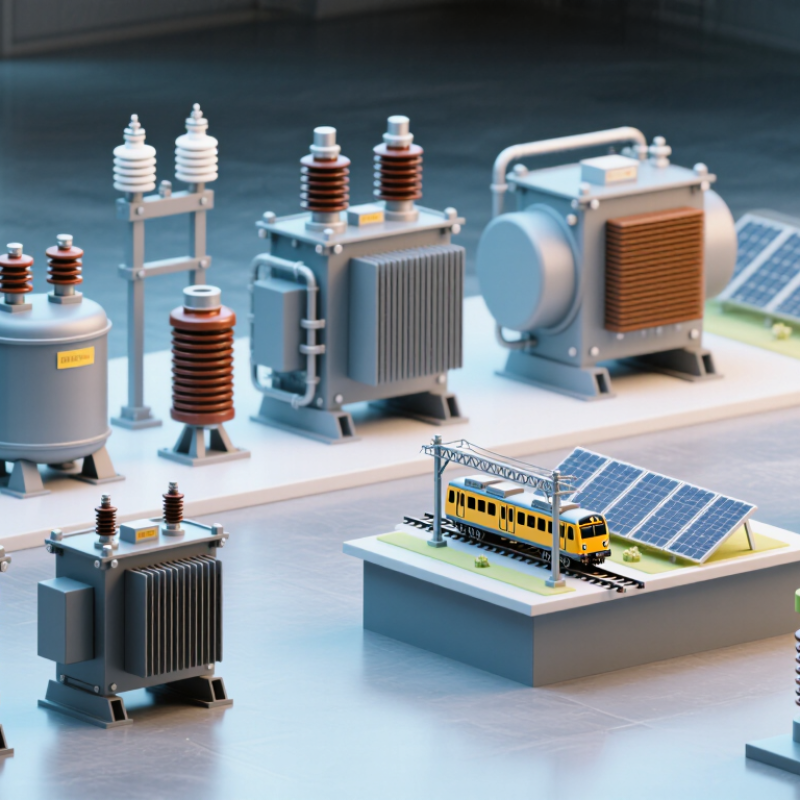
What Transformers Do and How They Work
A transformer transfers electrical energy between circuits through electromagnetic induction. Alternating current in the primary winding creates a changing magnetic field in the steel core. That field induces voltage in the secondary winding. The ratio of winding turns determines whether voltage rises or falls; frequency remains unchanged. In a substation, a step-down unit can reduce transmission voltage before power reaches local streets. Smaller distribution transformers then lower it for buildings. Losses still occur as heat in the core and windings. That hum is real.
Transformer demand matters as grids expand. The IEA’s 2023 report, Electricity Grids and Secure Energy Transitions, says annual grid investment needs to rise from about USD 300 billion to more than USD 600 billion by 2030. It also projects that 80 million kilometres of grids may need to be added or refurbished by 2040. A U.S. Department of Energy technical analysis estimated distribution transformer losses at roughly 61 terawatt-hours annually. Those figures make efficiency and correct sizing practical concerns, not just procurement details. Yet a nameplate rating alone cannot describe a real load. Operating hours, temperature, harmonics, and future demand all matter. I would check those assumptions twice; forecasts are often wrong.
10 Best Types Of Transformers for Global Buyers? – What Transformers Do and How They Work
| Transformer Type | What It Does and How It Works | Typical Applications | Key Buyer Considerations |
|---|---|---|---|
| 1. Power Transformer | Transfers electrical energy between circuits by electromagnetic induction. In transmission networks, it commonly changes voltage between high-voltage grid levels; its windings and magnetic core are designed for the specified voltage, frequency, and power. | Generating stations, transmission substations, and major grid interconnections. | Check rated power, primary and secondary voltages, frequency, impedance, cooling method, insulation level, tap range, and applicable grid requirements. |
| 2. Distribution Transformer | Steps medium-distribution voltage down to a lower voltage suitable for local distribution. It is generally designed for continuous service, with efficiency at typical operating loads an important consideration. | Utility distribution networks, commercial sites, residential areas, and industrial facilities. | Confirm voltage ratio, kVA rating, phase, connection configuration, expected load profile, installation location, losses, and local safety requirements. |
| 3. Isolation Transformer | Transfers AC power between electrically separate primary and secondary windings, usually with a 1:1 voltage ratio. It provides galvanic isolation but does not, by itself, guarantee protection from electric shock or remove all electrical noise. | Medical and laboratory equipment, control systems, maintenance work, and equipment requiring electrical separation. | Check input and output voltage, rated power, insulation rating, electrostatic shielding if required, grounding arrangements, and the applicable installation rules. |
| 4. Autotransformer | Uses one winding with taps shared by the input and output circuits to change voltage. Its compact design can use less copper and core material than a comparable two-winding transformer, but it does not provide galvanic isolation. | Voltage adjustment, motor starting, and interconnection of systems with relatively close voltage levels. | Verify the voltage ratio, load rating, starting duty if applicable, tap arrangement, short-circuit conditions, and whether electrical isolation is required. |
| 5. Current Transformer (CT) | Produces a smaller, proportional secondary current for metering or protection while isolating the measuring circuit from the primary conductor. A CT secondary must not be left open-circuited while primary current is flowing. | Power meters, energy monitoring, switchgear, and protective relays. | Specify primary and secondary current, ratio, accuracy class, burden, frequency, insulation level, and protection duty. Follow safe shorting and wiring procedures. |
| 6. Voltage Transformer (VT/PT) | Steps down system voltage to a proportional, standardized level for measurement and protection. Its secondary circuit is electrically isolated from the high-voltage primary circuit. | Voltage measurement, revenue metering, and voltage-based protection in substations and switchgear. | Check ratio, accuracy class, burden, system voltage, insulation level, connection configuration, and whether the design is intended for metering or protection. |
| 7. Dry-Type Transformer | Uses air or another gas as its cooling and insulating medium rather than a liquid insulating fluid. Windings are commonly exposed or encapsulated, depending on the design. | Indoor buildings, commercial properties, industrial plants, and locations where liquid containment is undesirable. | Assess ventilation, ambient temperature, enclosure and ingress protection, noise, fire requirements, altitude derating, and the specified cooling class. |
| 8. Oil-Immersed Transformer | Places the core and windings in insulating liquid, which provides insulation and carries heat away from active parts. The liquid and cooling arrangement must be compatible with the installation and operating conditions. | Outdoor substations, utility distribution, and many medium- and high-power installations. | Review liquid type, cooling method, leak containment, fire and environmental rules, maintenance needs, ambient conditions, and required protection accessories. |
| 9. Toroidal Transformer | Uses a ring-shaped magnetic core with windings distributed around it. The geometry can reduce stray magnetic fields and audible hum compared with some conventional designs, though actual performance depends on construction and load. | Audio equipment, instrumentation, control systems, and compact power supplies. | Confirm voltage, VA rating, inrush current, regulation, mounting method, temperature rise, and any magnetic-field or noise limits. |
| 10. Rectifier Transformer | Supplies AC power to a rectifier system that converts it to DC. Depending on the design, it may include multiple secondary windings, phase shifts, or connections suited to the rectifier and its harmonic-current characteristics. | Industrial DC drives, electrochemical processes, large chargers, and other high-power DC systems. | Provide the rectifier topology, DC output requirements, duty cycle, harmonic spectrum, number of pulses, cooling needs, and required winding and connection details. |
Selection note: Transformer suitability depends on the complete electrical system and installation conditions. Confirm ratings, frequency, insulation coordination, efficiency requirements, protection, and local standards with a qualified electrical professional. Most conventional power transformers operate with alternating current and transfer energy through changing magnetic flux.